Published collaborative research · Secondary lymphedema
Secondary lymphedema
Integrating experimental tissue biology and single-cell analysis to investigate persistent inflammation in secondary lymphedema.
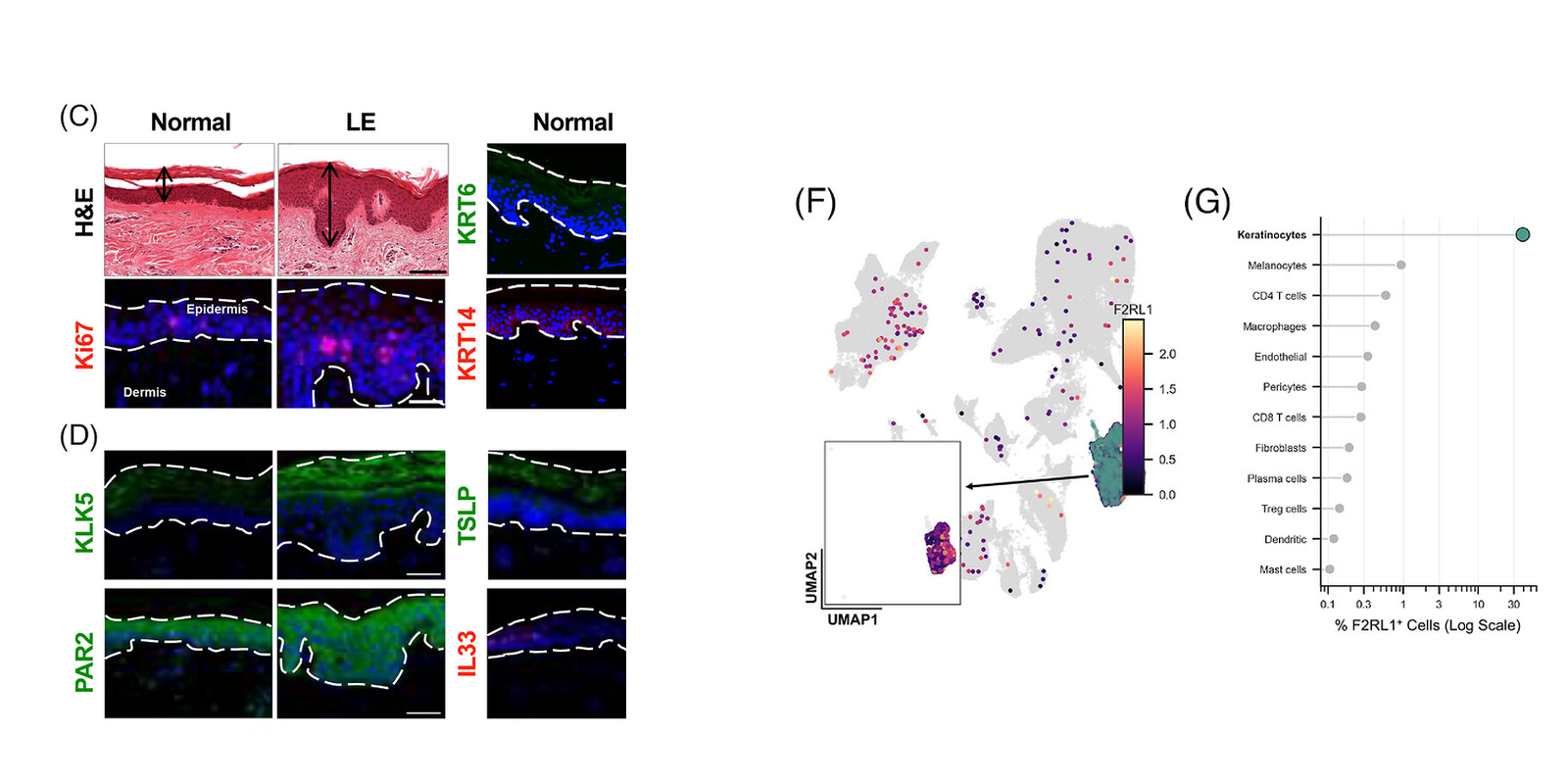
I contributed to a peer-reviewed study identifying a critical role for keratinocytes and protease-activated receptor 2 in secondary lymphedema development.
The work links epidermal inflammatory remodeling with cell-specific PAR2 biology and provides a mechanistic framework for understanding how epithelial responses contribute to chronic lymphatic disease.
I contributed the paired human skin single-cell analyses to a study of mast-cell heterogeneity and inflammatory remodeling in secondary lymphedema. The analysis examines transcriptional programs and cell states using donor-aware statistical comparisons, subclustering, reference mapping, and exploratory state-modeling methods.
The computational workflow, MastAMP, organizes these analyses and their figure-generation procedures. The manuscript has received a favorable editorial decision from JCI Insight and is conditionally accepted pending revision.
Manuscript figures and the MastAMP code repository will be linked when available for public release.
I also co-authored a peer-reviewed review examining how transcriptomic, proteomic, single-cell, and related omics approaches are reshaping the study of secondary lymphedema pathophysiology.
The review focuses on moving beyond fluid stasis as a complete explanation of disease toward a systems-level view of persistent epithelial, stromal, immune, and lymphatic remodeling.
Published outputs
Related work
-
Critical Role of Keratinocytes and Protease-Activated Receptor 2 in Secondary Lymphedema Development
-
From Stasis to Systematics: Deciphering the Pathophysiology of Secondary Lymphedema Through Omics
-
Critical role of skin mast cells in secondary lymphedema pathology (working manuscript title)